

The age-old debate between cat and dog enthusiasts has raged for centuries, with each side claiming their preferred pet reigns supreme in the intelligence department. This fascinating question touches on fundamental aspects of animal cognition, evolution, and the unique ways different species have adapted to survive and thrive alongside humans.
When we explore whether cats are smarter than dogs, we’re diving into a complex world of comparative psychology that challenges our understanding of what intelligence truly means. Both cats and dogs have evolved distinct cognitive abilities that serve their respective survival strategies, making direct comparisons both intriguing and scientifically challenging.
Defining Animal Intelligence
Understanding animal intelligence requires us to move beyond human-centric definitions and consider the various forms cognitive abilities can take. Intelligence in animals encompasses problem-solving skills, adaptability, memory retention, learning capacity, and the ability to navigate complex social and environmental situations. The American Psychological Association recognizes that animal intelligence manifests differently across species based on their evolutionary needs and ecological niches.
Traditional intelligence tests designed for humans often fail to capture the full spectrum of animal cognitive abilities. Cats and dogs have evolved different survival strategies over millions of years, leading to specialized forms of intelligence that reflect their ancestral roles as solitary hunters versus pack animals. This fundamental difference shapes how we should evaluate and compare their cognitive capabilities.
Modern animal cognition research emphasizes the importance of species-appropriate testing methods that account for each animal’s natural behaviors and motivations. What appears as stubbornness in cats might actually reflect a different approach to problem-solving, while dogs’ eagerness to please humans can sometimes mask their independent thinking abilities.
Brain Structure and Neurological Differences
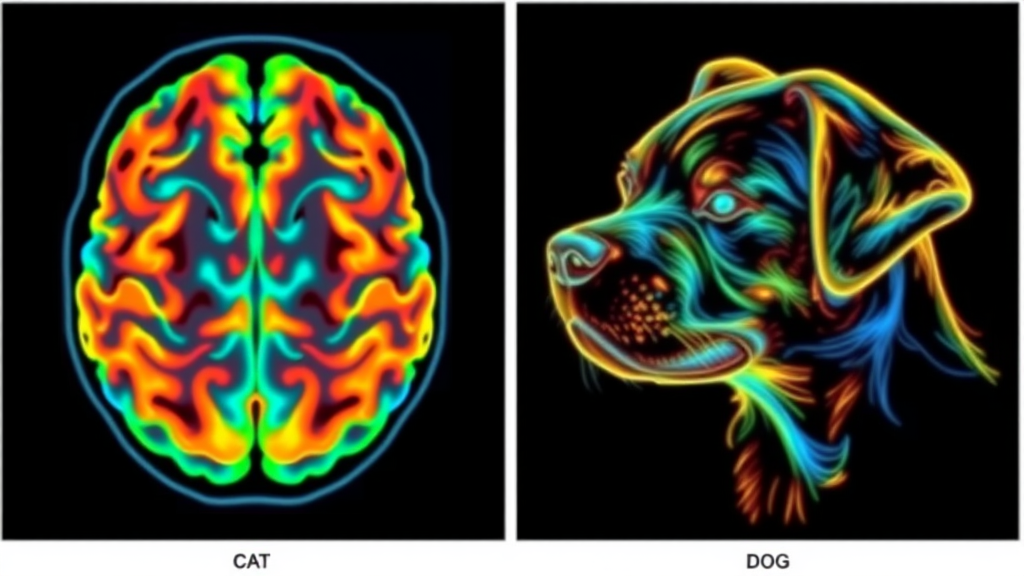
The neurological foundations of intelligence provide fascinating insights into the cognitive capabilities of cats and dogs. Dogs possess approximately 530 million neurons in their cerebral cortex, while cats have around 250 million neurons, according to research published in Frontiers in Neuroanatomy. However, neuron count alone doesn’t determine intelligence, as the organization and connectivity of these neurons play crucial roles.
The structure of the feline brain reveals adaptations for precise motor control, exceptional sensory processing, and independent decision-making. Cats have proportionally larger areas dedicated to processing auditory and visual information, reflecting their evolution as precise predators. Their brain’s organization supports rapid reflexes and acute spatial awareness, essential for successful hunting.
Canine brains show different organizational patterns, with enhanced areas for social processing and communication with humans. The domestication process has significantly influenced dog brain structure, with studies showing that breeds selected for specific traits exhibit corresponding neurological specializations. Cleverest dogs often demonstrate remarkable abilities to read human cues and adapt their behavior accordingly.
Problem-Solving Abilities
Problem-solving represents one of the most measurable aspects of animal intelligence, and both cats and dogs demonstrate remarkable abilities in this domain. Cats typically approach problems with patience and methodical analysis, often observing situations extensively before taking action. This behavior reflects their evolutionary heritage as ambush predators who must carefully plan their attacks.
Dogs generally exhibit more trial-and-error approaches to problem-solving, often seeking human guidance when faced with challenges. This collaborative problem-solving style has been enhanced through thousands of years of domestication and selective breeding. Research shows that dogs excel at using human communicative cues to solve problems, while cats prefer to work independently.
Laboratory studies comparing feline and canine problem-solving abilities reveal that both species can learn complex tasks, though their approaches differ significantly. Cats often demonstrate superior performance in tasks requiring patience and precision, while dogs excel in cooperative problem-solving scenarios. The National Center for Biotechnology Information has documented numerous studies highlighting these species-specific problem-solving strategies.
Social Intelligence and Communication
Social intelligence represents a crucial component of overall cognitive ability, and here we see perhaps the most significant differences between cats and dogs. Dogs have evolved sophisticated social intelligence that allows them to integrate seamlessly into human family structures. They can read human facial expressions, respond to pointing gestures, and even demonstrate empathy toward their owners.
Feline social intelligence operates differently, reflecting their evolutionary background as primarily solitary animals. However, domestic cats have developed remarkable abilities to communicate with humans through vocalizations, with adult cats retaining kitten-like meows specifically for human interaction. This suggests a form of adaptive intelligence that allows cats to manipulate human behavior to their advantage.
The question of dogs understanding English highlights the sophisticated communication abilities many canines possess. Dogs can learn hundreds of words and respond to complex verbal commands, demonstrating their capacity for symbolic understanding. Cats, while less responsive to verbal commands, show sophisticated non-verbal communication skills and can learn to associate specific sounds with desired outcomes.
Memory and Learning Capacity
Memory and learning capacity provide another lens through which we can examine feline and canine intelligence. Both species demonstrate impressive long-term memory abilities, though they utilize these capabilities in different ways. Cats excel at spatial memory, remembering the locations of important resources, safe hiding spots, and territorial boundaries with remarkable precision.
Dogs show exceptional episodic memory, remembering specific events, people, and experiences with remarkable detail. They can recall complex sequences of actions and demonstrate anticipatory behavior based on past experiences. This type of memory serves their social nature well, allowing them to maintain relationships and navigate complex social hierarchies.
Learning capacity varies significantly between individual animals, regardless of species. Some cats demonstrate remarkable ability to learn tricks and respond to training, while certain dogs may struggle with basic commands. Factors such as genetics, early socialization, and individual personality play crucial roles in determining learning capacity. Research on conditions like dogs having autism has revealed how neurological differences can affect learning and social behavior.
Evolutionary Adaptations and Survival Skills
The evolutionary history of cats and dogs has shaped their intelligence in fundamentally different ways. Cats evolved as solitary predators, developing keen senses, precise motor control, and independent decision-making abilities. These adaptations required sophisticated cognitive abilities for tracking prey, avoiding predators, and efficiently utilizing energy resources.
Dogs evolved from pack-hunting wolves, necessitating complex social cognition, communication skills, and cooperative problem-solving abilities. Their intelligence developed to support group hunting strategies, hierarchical social structures, and resource sharing. This evolutionary background explains why dogs generally show greater responsiveness to human direction and social cues.
Both species have undergone significant changes through domestication, but these changes have affected their intelligence differently. The Smithsonian Institution documents how selective breeding has enhanced certain cognitive traits while potentially diminishing others. Understanding these evolutionary influences helps explain why direct intelligence comparisons can be misleading.
Scientific Research and Studies
Scientific research into animal intelligence has produced fascinating insights into the cognitive capabilities of both cats and dogs. The landmark studies by Dr. Suzana Herculano-Houzel on cortical neuron counts provided important neurological data, while behavioral studies have revealed the practical applications of animal intelligence in real-world scenarios.
Comparative cognition research faces unique challenges when studying cats versus dogs. Dogs’ eagerness to participate in human-directed activities makes them ideal research subjects, while cats’ independence and different motivational structures can make controlled studies more difficult. This research bias may have historically skewed perceptions of relative intelligence between the species.
Recent studies published in journals like Animal Cognition have begun to address these methodological challenges by developing species-appropriate testing protocols. These studies reveal that both cats and dogs possess sophisticated cognitive abilities that serve their respective ecological niches and survival strategies.
Practical Intelligence in Daily Life
Practical intelligence manifests differently in cats and dogs, reflecting their distinct relationships with humans and their environments. Cats demonstrate remarkable practical intelligence through their ability to train humans to meet their needs, often using subtle behavioral cues and vocalizations to communicate desires for food, attention, or access to preferred locations.
Dogs exhibit practical intelligence through their service roles, working abilities, and integration into human activities. From guide dogs for the visually impaired to detection dogs working in law enforcement, canines demonstrate remarkable ability to learn complex tasks and perform them reliably. The debate over why dogs are better than cats often centers on these practical applications of canine intelligence.
Both species show adaptive intelligence in navigating modern environments, learning to use pet doors, operate puzzle feeders, and even manipulate electronic devices. Cats often surprise owners with their ability to open doors, turn on faucets, and solve mechanical puzzles, while dogs excel at learning routines and anticipating human needs. Some owners even notice interesting dynamics when considering whether dogs can be allergic to cats, which can affect their behavioral interactions.
Frequently Asked Questions
Are cats actually smarter than dogs?
The question of whether cats are smarter than dogs doesn’t have a simple answer because intelligence manifests differently in each species. Cats excel in areas like independent problem-solving, spatial memory, and sensory processing, while dogs demonstrate superior social intelligence, trainability, and cooperative abilities. Both species have evolved cognitive abilities that serve their specific evolutionary needs and survival strategies.
What makes dogs appear more intelligent than cats?
Dogs often appear more intelligent because they’re more eager to please humans and participate in training activities. Their social nature and thousands of years of selective breeding for human cooperation make them more responsive to commands and more likely to demonstrate learned behaviors. However, this willingness to engage doesn’t necessarily indicate superior intelligence—cats may simply be less motivated to perform on command.
Can cats learn tricks like dogs do?
Yes, cats can learn tricks and complex behaviors, though they may require different training approaches than dogs. Cats respond well to positive reinforcement and clicker training, but their independent nature means they may choose when to perform learned behaviors. Many cats can learn to sit, shake hands, come when called, and even perform agility courses when properly motivated.
How do scientists measure intelligence in cats and dogs?
Scientists use various methods to measure animal intelligence, including problem-solving tests, memory assessments, social cognition experiments, and neurological studies. Researchers design species-appropriate tests that account for each animal’s natural behaviors and motivations. For example, cats might be tested using hunting-related scenarios, while dogs might be evaluated through social cooperation tasks.
Do certain breeds of cats or dogs show higher intelligence?
Yes, certain breeds within both species tend to demonstrate higher intelligence in specific areas. Among dogs, Border Collies, Poodles, and German Shepherds often rank highly in trainability and problem-solving. In cats, breeds like Siamese, Abyssinian, and Scottish Fold are known for their intelligence and interactive nature. However, individual variation within breeds can be significant, and intelligence can manifest in many different ways.
What role does domestication play in cat and dog intelligence?
Domestication has significantly influenced the intelligence of both cats and dogs, though in different ways. Dogs have undergone more intensive selective breeding, which has enhanced their ability to communicate with humans and work cooperatively. Cats have retained more of their wild cognitive abilities while developing specific skills for living with humans, such as vocal communication and behavioral manipulation.
Can cats and dogs understand human emotions?
Both cats and dogs can recognize and respond to human emotions, though they may express this understanding differently. Dogs are generally more obvious in their emotional responses to human moods, often providing comfort when owners are distressed. Cats also respond to human emotions but may do so more subtly, such as by staying close during illness or stress. Research suggests both species can read facial expressions and vocal cues to gauge human emotional states.





