Most dog owners think dog poop public health is somebody else’s concern — until they hear that the EPA classifies pet waste as a non-point pollutant in the same category as agricultural runoff. The truth is dog poop public health impacts go well beyond your own yard. Here are the 5 best reasons dog poop public health matters at the neighborhood, watershed, and community level — plus what each dog owner can actually do.

Why dog poop public health is a real category
The US has approximately 90 million dogs. Average daily waste per dog: ~3/4 lb. Total daily output: ~30 million pounds. Multiply by 365 days: ~11 billion pounds of dog waste produced annually in the US.
If even 20% of that goes uncollected and enters the environment, it equals roughly the waste output of a city of 100 million people from a public health standpoint. This is why municipalities increasingly treat pet waste as a community issue, not a personal one.
The 5 best reasons dog poop public health matters
1. Waterway contamination
The biggest single concern. Rain washes dog waste into storm drains, which often discharge directly into rivers, lakes, and bays — not into sewage treatment. The contamination shows up as:
- Elevated fecal coliform counts in swimming areas (forcing beach closures)
- Nitrogen and phosphorus enrichment that triggers algae blooms
- Pathogen loads (E. coli, Salmonella, Cryptosporidium) reaching drinking water sources
The EPA’s overview of pet waste as a non-point pollution source documents this in detail. A single gram of dog waste can contain 23 million fecal coliform bacteria — that’s higher per-gram than human waste.
2. Parasite transmission to humans
Several dog parasites can transmit to people:
- Toxocara canis (roundworm) — most common zoonotic risk. Eggs in soil can survive 7+ years. Infection in humans causes visceral larva migrans, especially dangerous to children who play in contaminated soil.
- Ancylostoma (hookworm) — penetrates skin barefoot. Causes cutaneous larva migrans.
- Giardia — fecal-oral transmission. Cysts survive in soil for weeks.
- Cryptosporidium — same transmission pattern.
Kids are the highest-risk group because of hand-to-mouth behavior in yards and parks. See our worms in dog poop guide for what’s identifiable visually.
3. Soil pathogen reservoirs
Even after dog waste decomposes, parasite eggs and bacterial cysts persist in soil for months to years. Public parks, dog parks, and shared green spaces where pickup is inconsistent become long-term reservoirs.
This is why dog parks have higher zoonotic disease rates than private yards — every uncollected pile contributes to the soil load. The cumulative effect is the public health concern, not the single pile.
4. Vector amplification (flies, rodents)
Dog waste in residential areas attracts flies and supports rodent populations, both of which mechanically spread pathogens beyond the original site. See our dog poop flies guide for the fly side.
One household leaving dog waste affects the fly and rodent population for the entire block. Dog poop public health concerns ripple outward in literal terms.
5. Air quality and aerosolized pathogens
Less discussed but real: dried dog waste in urban areas becomes part of airborne particulate matter. Studies in cities with high dog populations have found dog-fecal-derived bacteria in air samples. Not the dominant air quality issue but a measurable contributor.
For households with allergic or immunocompromised members, the air-quality angle matters even more than the waterway one.
What individual dog owners can do (most impactful first)
Five actions ranked by community-level impact:
- Daily yard pickup. Stops contamination at the source. See pick up in own yard guide for why even private yards matter.
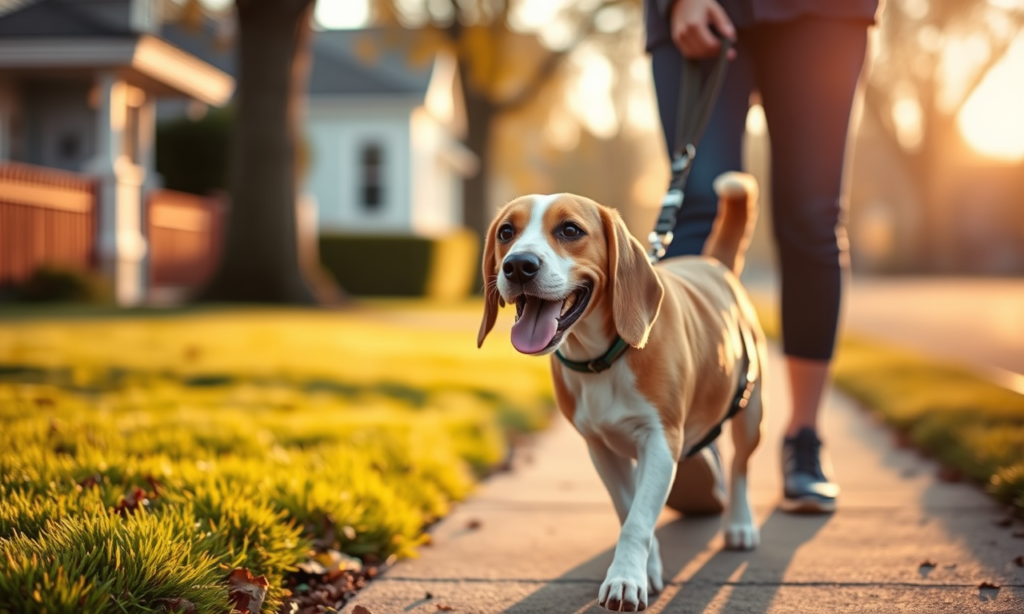
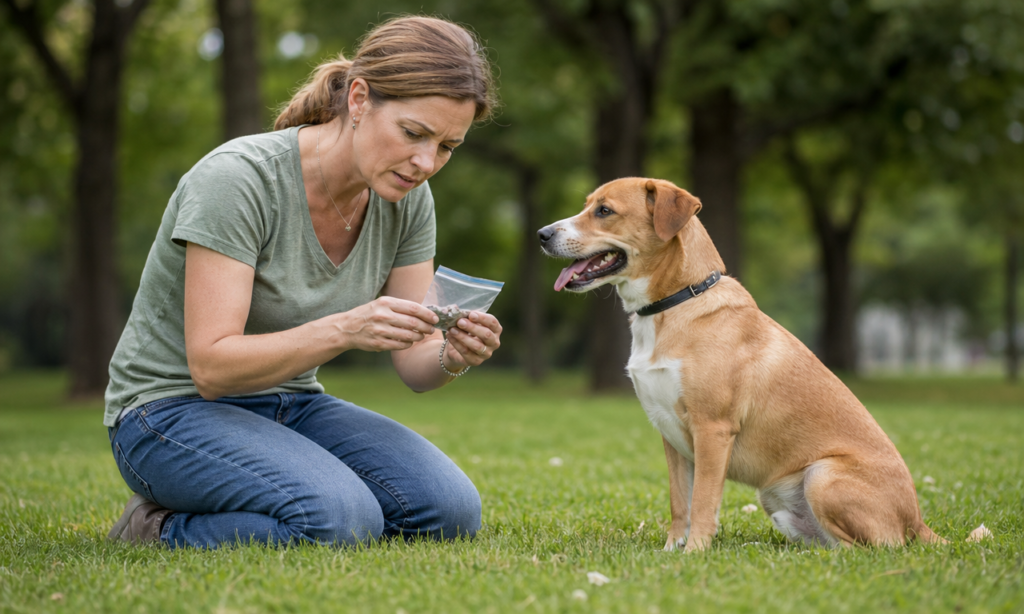
- Always carry bags on walks. Public pickup is the most direct dog poop public health contribution.
- Bag-and-trash, not bag-and-leave. A bagged stool by the curb still spreads. Take it home or to a designated bin.
- Don’t compost in vegetable gardens. Backyard compost doesn’t reach pathogen-killing temperatures.
- Skip “flushable” pet waste systems unless approved. Many local sewer systems aren’t designed for it.
If your community has dog parks or shared green spaces, voluntary pickup beyond your own dog’s waste contributes a lot. Picking up a couple extra piles per visit is one of the highest community-impact-to-effort ratios in public health.
What communities can do
Three policies that move the needle at the municipal level:
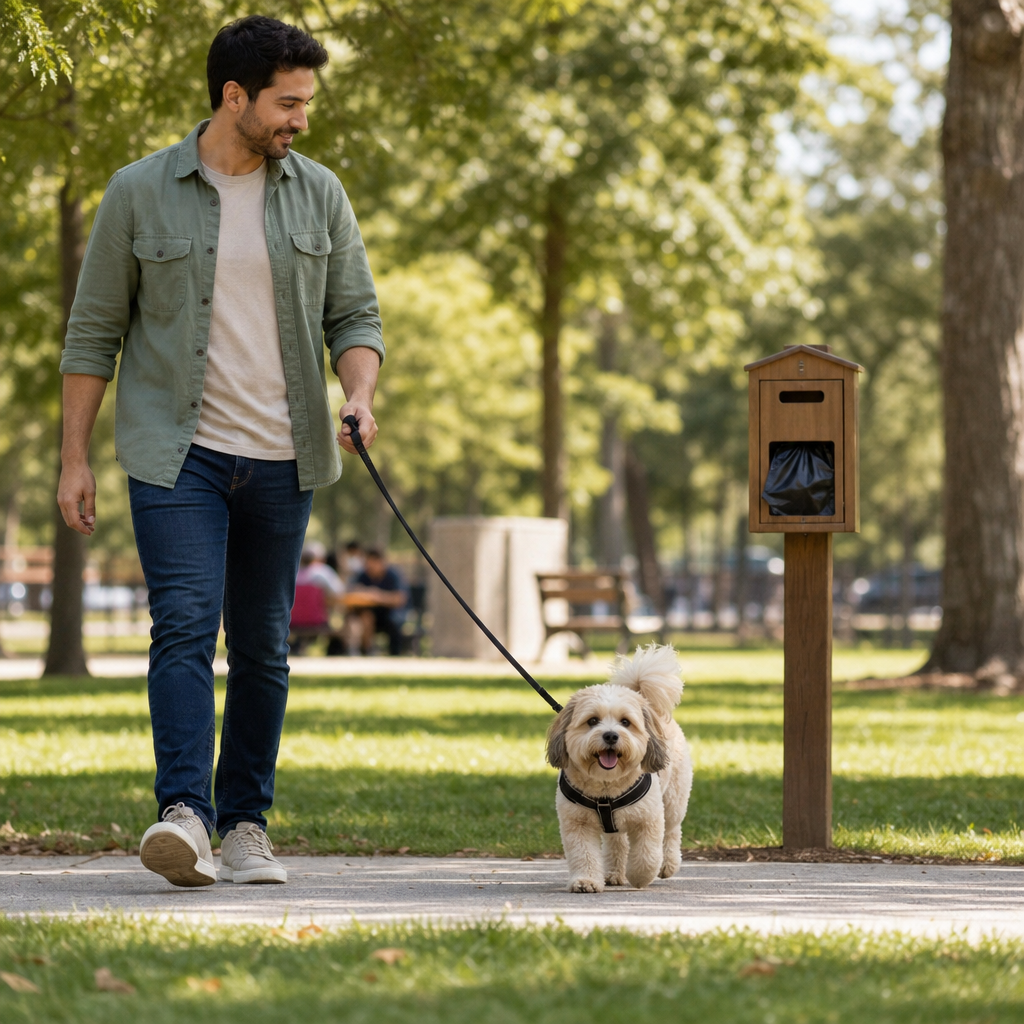
- Pet waste stations with bags and bins at parks. Free, available, accessible — increases pickup compliance dramatically.
- Public-awareness campaigns. Most uncollected waste comes from owners who don’t realize the community impact.
- Fines for non-pickup in public spaces. Controversial but effective when paired with adequate bin infrastructure.
Some cities have introduced “DNA registry” programs for residential apartment complexes — every dog DNA-tested at move-in, uncollected waste tested and matched. Effective but pricey and divisive.
The dog parent’s mental model shift
The biggest dog poop public health barrier isn’t laziness — it’s the mental framing that “it’s just my dog’s waste.” Once you understand the cumulative effect across millions of pet households, individual pickup feels less like a chore and more like a small civic contribution. Same logic as recycling or not littering: any single action is negligible; the aggregate matters a lot.
For specific scenarios where pickup is hardest (winter, illness, mobility), see our pickup service cost guide — hiring help is a legitimate dog poop public health solution.
What about wild animal waste?
Common counter-argument: “What about deer or raccoon waste?” Three answers:
- Wild animal waste decomposes faster and is spread across larger areas — lower per-acre concentration.
- Wildlife carries fewer parasites transmissible to humans than dogs do (closer to our species).
- Dog populations in residential areas are 5-50x denser than wildlife populations in the same area.
The math just isn’t comparable. Wild animals aren’t the public health concern that dense urban/suburban dog populations are.
Particular concerns for kids and immunocompromised
Three groups for whom dog poop public health is heightened:
- Children under 5. Hand-to-mouth behavior + crawling in grass/dirt. Toxocariasis cases are highest in this age group.
- Pregnant women. Some dog parasites can cross the placenta.
- Immunocompromised adults. Lower threshold for serious infection from typical pathogens.
If your household has anyone in these groups, treating yard cleanup as serious is appropriate. See our poop color chart for clinical signs to watch.
FAQ
Are biodegradable bags an environmental win? Yes for landfill behavior, neutral for the pickup problem itself. The pickup matters way more than the bag material.
What about service dog and police-K9 waste? Same rules apply. Even working dogs need cleanup.
Is my city’s storm drain really untreated? Most US cities have separate storm and sewer systems. Storm drains discharge directly to waterways without treatment. Check your local utility to confirm.
Do I need to clean up if I’m walking in a forested area? Yes. Forest soil isn’t a pathogen-killing barrier — parasites survive in soil regardless of setting.
Can I just bury dog waste in my yard? Not in vegetable garden areas or near drainage. Deep burial (12+ inches) away from gardens is acceptable but more work than bag-and-trash.
Bottom line
Dog poop public health concerns are real and well-documented: waterway contamination, parasite transmission, soil reservoirs, fly/rodent amplification, and air quality. The five biggest individual actions: daily pickup in your yard, always-bag-on-walks, bag-and-trash never-bag-and-leave, skip composting in food gardens, and follow local rules on flushing. The cumulative effect across millions of households is the public health story — your individual habit contributes one share of either solution or problem.
This article is general information, not veterinary advice. If your dog is sick, talk to your vet.