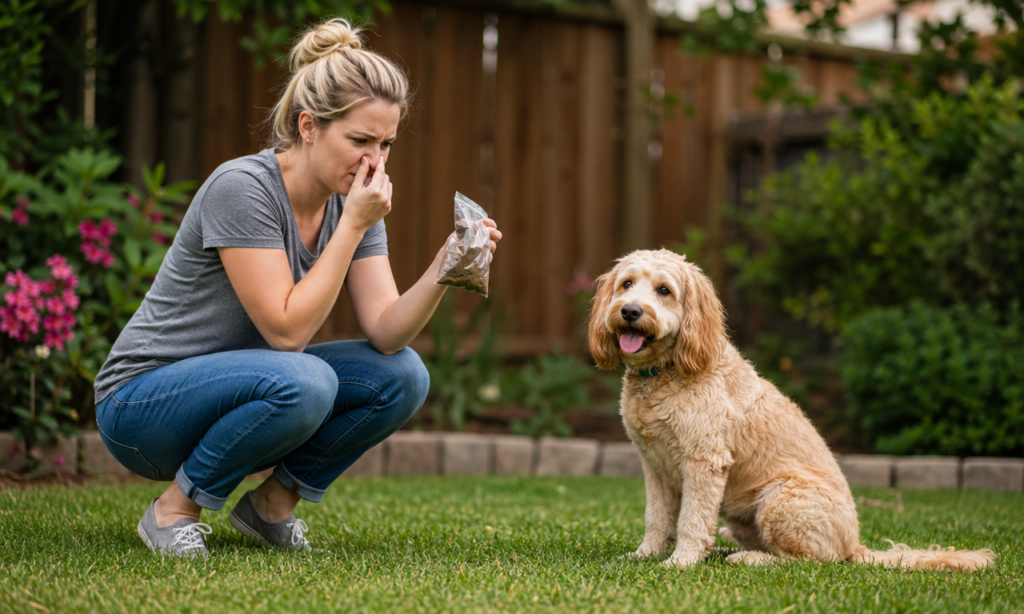
If your dog pooping blood no other symptoms is the situation you’re facing right now, the urgency depends on what kind of blood and how much. Dog pooping blood no other symptoms can be anything from a minor dietary scrape to an early sign of something serious — and the difference comes down to color and pattern. Below are the 5 best explanations, when to relax overnight, and when to call the vet now.
First — what kind of blood are you seeing?
Two visually distinct patterns matter:
- Fresh red blood (bright crimson, streaks, droplets). Lower-GI bleeding — colon, rectum, or anus. Often looks streaky on otherwise normal stool.
- Black tarry stool (melena). Upper-GI bleeding — stomach or small intestine. The blood is digested by the time it exits, making it dark. See our black tarry stool guide for the specifics.
Fresh red blood without other symptoms is often less urgent than melena. Melena always warrants a vet call even if the dog seems fine — digested blood means the bleeding is more proximal and you can’t see how much there is.
5 best explanations for dog pooping blood no other symptoms
1. Dietary indiscretion (most common)
Eating something they shouldn’t — a bone fragment, a sock corner, garbage, rich human food — can scrape the colon lining and produce streaks of fresh red blood. The dog otherwise feels fine because the cause has already passed. This is the most common reason for dog pooping blood no other symptoms in healthy dogs.
What to do: bland diet (boiled chicken + rice) for 24-48 hours, monitor stool. Usually resolves on its own. If blood persists past 2-3 stools, call the vet.
2. Stress colitis
Acute stress (boarding, thunderstorms, new home, travel) can inflame the colon and produce fresh red streaks. Otherwise the dog acts normal because the trigger is psychological, not pathogen-driven.
Common after: kennel stays, vet visits, fireworks, household changes. Resolves within 2-3 days when stress passes. Probiotics can speed recovery — see our probiotics guide.
3. Anal gland issues
Impacted or infected anal glands sometimes leak blood that appears on the outside of stool. The dog may not show pain at this stage but might scoot, lick the area, or have a slight odor. See our anal gland guide for the full picture.
If the blood is ONLY on the surface of an otherwise firm stool and your dog has been scooting, anal glands are the likely cause. Vet visit for expression is the fix.
4. Parasites (worms, giardia, hookworms)
Some intestinal parasites cause mild GI bleeding that shows as blood streaks without making the dog visibly sick. Hookworms in particular can produce blood-tinged stool while the dog acts fine. See worms in dog poop for identification.
If your dog is overdue for deworming, ask the vet to run a fecal at the next visit. Easy to diagnose and easy to treat.
5. Early HGE (hemorrhagic gastroenteritis)
Less common but worth knowing. HGE produces bright red bloody diarrhea, often described as “raspberry jam” stool. Early-stage HGE may present as just a small amount of red blood with the dog still feeling fine. Within hours, it can progress to severe symptoms.
If the blood looks like fresh raspberry jam (not just streaks) — call the vet today, even without other symptoms. HGE can deteriorate fast, and dog pooping blood no other symptoms is exactly how early HGE presents before the rest of the symptoms appear.
Dog pooping blood no other symptoms — when to watch vs call vet
Watch overnight if all of these are true:
- Streaks or small drops of fresh red blood only
- Dog eating, drinking, and acting normal
- No vomiting
- Energy level normal
- You can identify a likely trigger (table scraps, stress, recent boarding)
Call the vet within 24 hours if:
- Blood persists past 2-3 stools
- Dog is a senior (7+) or puppy (under 6 months)
- Recent change in food and bleeding hasn’t stopped after switching back
- You found anything unusual in the yard or chewed
Call the vet immediately (same day) if:
- Black tarry stool (melena) — even without other symptoms
- Large amount of fresh red blood, especially clots
- “Raspberry jam” appearance
- Dog suddenly drops energy, refuses food, or starts vomiting
- Visible bleeding from the anus
The AKC bloody stool guide has a useful summary of the standard veterinary approach if you want to read more.
What to do at home for mild cases
If your dog pooping blood no other symptoms fits the “watch overnight” category:
- Skip the next meal. Let the gut rest for 12 hours. Water is fine.
- Then start bland diet. Boiled chicken (no skin/seasoning) + plain white rice in a 50/50 mix, smaller-than-usual portions.
- Watch every stool for the next 48 hours. Note color, consistency, frequency.
- Add probiotic if available. FortiFlora or plain unsweetened yogurt can speed colon recovery.
- Resume normal food gradually over 2-3 days. Mix increasing amounts of regular kibble into the bland diet.
This protocol resolves most mild stress or dietary cases within 24-48 hours.
What about the consistency of the stool?
The texture matters along with the blood:
- Normal-shaped stool with blood streaks. Usually colon-surface irritation. Lower urgency.
- Loose stool with blood. Colitis (inflammation). See our diarrhea guide for the next steps.
- Watery stool with blood. Higher urgency — possible HGE or infection.
- Mucus + blood. Often parasites or significant colitis — see mucus in dog poop.
Common myths about dog pooping blood no other symptoms
- “A little blood is always fine.” Not always — melena (digested blood) is never benign. Color matters.
- “My dog is acting fine so it can’t be serious.” Some serious GI issues hide for hours before symptoms emerge. Watch closely.
- “It’s just hemorrhoids.” Dogs don’t get hemorrhoids the way humans do. If you see what looks like one, it’s likely an anal gland issue or polyp.
- “Bones in stool always cause this.” Mostly true — but other dietary triggers (rich food, garbage, table scraps) cause it too. Don’t assume bones unless you know they were eaten.
FAQ
How much blood is “too much” to wait? Streaks or a few drops: usually safe to watch overnight. A teaspoon or more, or a stool that’s noticeably bloody throughout: vet today.
Could it be from a torn nail or paw cut? Possible if blood looks like it landed on the stool after, not mixed in. Check paws and tail for cuts before panicking.
What about female dogs in heat? Heat blood can drip near stool and look like it’s mixed in. Check the source first — heat blood comes from the vulva, not the anus.
Does diet change cause this? Yes — sudden food switches commonly cause colitis with light bleeding. Switch back to the old food and the issue usually resolves in 2-3 days.
Bottom line
Dog pooping blood no other symptoms is most often dietary or stress-related and resolves in 24-48 hours with a bland diet. Streaks of fresh red blood with a normal-acting dog can usually be watched overnight. Black tarry stool, raspberry-jam appearance, or large amounts of blood always need same-day vet attention regardless of how the dog seems otherwise. Trust color and pattern over the dog’s mood — dog pooping blood no other symptoms is a snapshot, not a guarantee the issue is mild.
This article is general information, not veterinary advice. If your dog is sick, talk to your vet.